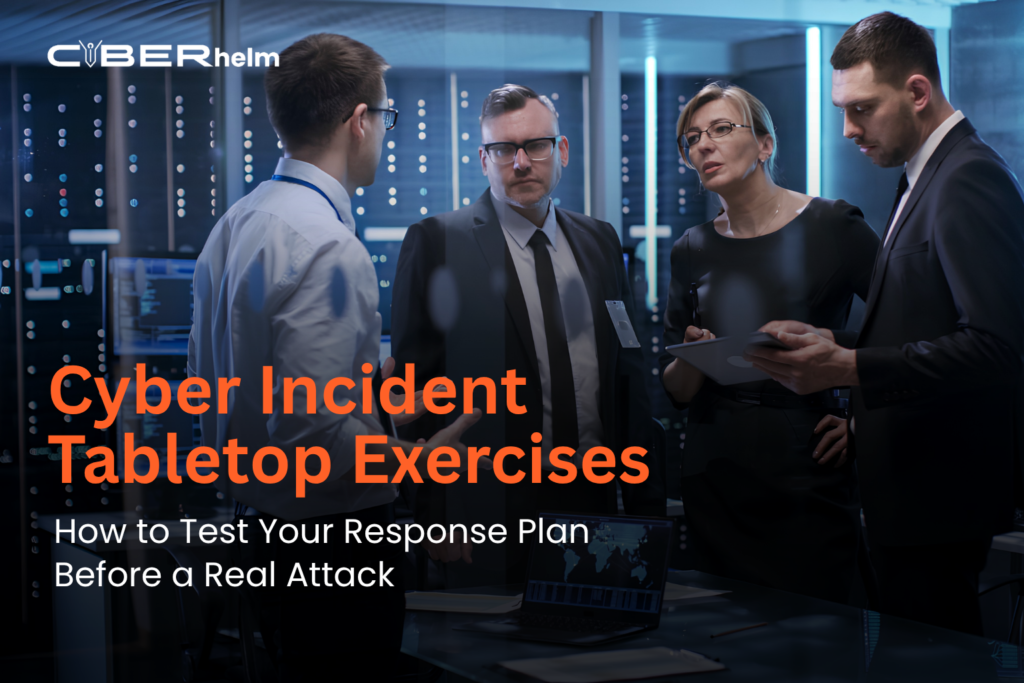
Cyber Incident Tabletop Exercises: How to Test Your Response Plan Before a Real Attack
Most organisations have an incident-response plan. Fewer organisations know whether that plan will work during a real cyberattack.
A written plan may look complete until a ransomware incident begins, customer systems become unavailable, senior leaders demand answers, regulators require information, and employees start receiving calls from journalists.
A cyber incident tabletop exercise helps an organisation test its response in a safe and controlled environment.
Instead of attacking live systems, participants discuss how they would respond to a realistic scenario. The exercise reveals unclear responsibilities, missing information, communication delays, technical gaps, and business-continuity weaknesses before a genuine crisis occurs.
CyberHelm helps enterprises and government organisations strengthen their ability to detect, contain, investigate, respond to, and recover from modern cyber incidents.
What Is a Cyber Incident Tabletop Exercise?
A cyber incident tabletop exercise is a structured discussion based on a realistic cybersecurity scenario.
A facilitator presents a series of events, often called injects. Participants explain what actions they would take, who they would contact, what information they would need, and which decisions they would make.
An exercise may simulate:
- Ransomware
- Data theft
- Compromised cloud accounts
- Insider threats
- Supply-chain attacks
- Business email compromise
- Lost or stolen devices
- Customer-data exposure
- Distributed denial-of-service attacks
- Critical vendor outages
The purpose is not to test participants with trick questions. It is to understand how well the organisation’s people, processes, technology, leadership, and communication channels work together.
Why Incident-Response Plans Fail in Real Situations
An incident plan can fail even when the document itself appears detailed.
Common reasons include:
Roles Are Not Clear
Several people may believe someone else is responsible for declaring the incident, contacting leadership, preserving evidence, or informing customers.
Contact Information Is Outdated
The response plan may contain old telephone numbers, former employees, expired supplier contacts, or unavailable legal advisors.
Business and Technical Teams Work Separately
The security team may focus on containment while leadership focuses on customers, revenue, regulators, and reputation. Without coordination, both sides can make decisions based on incomplete information.
Important Systems Are Not Prioritised
Teams may not agree on which services must be recovered first.
Communication Channels Are Compromised
If email, identity systems, or collaboration platforms are unavailable, the organisation may have no approved alternative.
Decisions Require Unavailable Approval
A critical action may depend on an executive, legal advisor, or system owner who cannot be reached.
CyberHelm’s Defensive Security services support incident response, digital forensics, breach investigation, threat hunting, SIEM optimisation, disaster recovery, and business continuity.
Benefits of Cyber Incident Tabletop Exercises
A well-designed tabletop exercise can help an organisation:
- Confirm response roles
- Test escalation procedures
- Improve cross-department coordination
- Identify missing information
- Validate communication plans
- Review legal and regulatory obligations
- Test business-continuity decisions
- Examine vendor dependencies
- Prioritise recovery
- Create measurable improvement actions
Tabletop exercises can also help senior leaders understand cybersecurity risk in business terms.
A technical vulnerability becomes easier to understand when leaders see how it could interrupt operations, affect customers, delay services, create legal exposure, and damage trust.
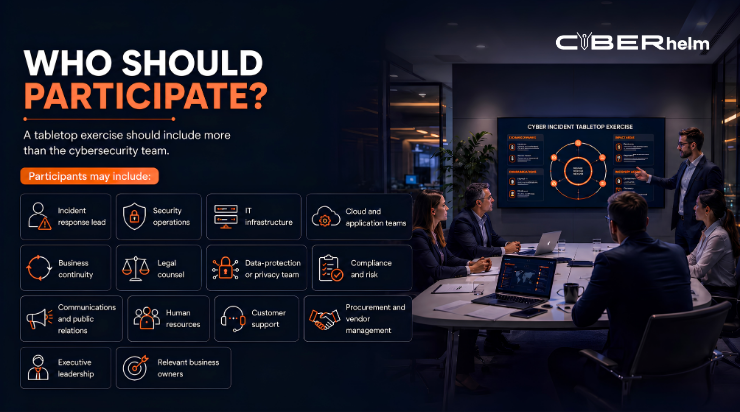
Who Should Participate?
A tabletop exercise should include more than the cybersecurity team.
Participants may include:
- Incident-response lead
- Security operations
- IT infrastructure
- Cloud and application teams
- Business continuity
- Legal counsel
- Data-protection or privacy team
- Compliance and risk
- Communications and public relations
- Human resources
- Customer support
- Procurement and vendor management
- Executive leadership
- Relevant business owners
Different participants bring different responsibilities. Technical teams explain what can be contained or restored. Legal and compliance teams identify reporting obligations. Communications teams manage internal and external messaging. Executives make decisions about risk, resources, customers, and business operations.
How to Plan a Cyber Incident Tabletop Exercise
1. Define the Objective
Do not begin by creating a dramatic attack story. Begin by deciding what the exercise needs to test.
Possible objectives include:
- Testing ransomware response
- Reviewing executive decision-making
- Validating cloud incident procedures
- Testing third-party coordination
- Examining regulatory notification
- Reviewing business continuity
- Testing alternative communications
- Evaluating forensic readiness
- Validating escalation procedures
- Testing customer-response processes
A clear objective keeps the exercise focused and makes the results easier to measure.
2. Select a Realistic Scenario
The scenario should reflect the organisation’s technology, industry, threat exposure, and business model.
A healthcare provider may test patient-system disruption. A financial organisation may simulate compromised payment data. A retailer may focus on ransomware during a busy sales period. A government organisation may test disruption to public services.
CyberHelm’s Offensive Security approach uses realistic adversary behaviour and attack paths to expose weaknesses before real attackers find them. The same threat-informed thinking can make tabletop scenarios more relevant.
3. Establish Exercise Boundaries
Participants should understand that the exercise is a simulation.
Define:
- Exercise date and duration
- Participants and observers
- Systems in scope
- Scenario assumptions
- Information participants can request
- Rules for pausing the exercise
- How observations will be recorded
- Who will receive the final report
A tabletop exercise normally does not involve changes to production systems unless a separate technical simulation has been approved.
4. Create a Scenario Timeline
The facilitator should introduce the incident in stages.
For example:
Stage 1: Employees report they cannot access shared files.
Stage 2: Security tools identify suspicious encryption activity.
Stage 3: A ransom message appears on several systems.
Stage 4: The organisation discovers that backups may also be affected.
Stage 5: A threat actor claims to have stolen customer data.
Stage 6: A journalist contacts the communications team.
Stage 7: A regulator requests information.
Each inject should require participants to discuss decisions, actions, ownership, and communication.
CyberHelm’s Cyber Solutions provide threat intelligence, dark-web monitoring, digital-risk protection, credential-leak detection, and external exposure visibility that can support realistic incident scenarios.
5. Prepare Discussion Questions
Useful questions include:
- Who declares this a major incident?
- Who has authority to isolate systems?
- Which systems must remain operational?
- How do we confirm what data was affected?
- Who contacts law enforcement?
- Who contacts the cyber-insurance provider?
- When should customers be informed?
- How will employees receive instructions?
- What happens if email is unavailable?
- Which vendor contacts are required?
- Who approves public statements?
- How will evidence be preserved?
- Can backups be trusted?
- Who decides the recovery order?
- What information will the board receive?
The facilitator should ask for specific names, tools, contacts, and procedures instead of accepting answers such as “IT will handle it.”
6. Review Governance and Compliance Requirements
The exercise should examine whether incident decisions align with internal policies, contracts, regulations, and reporting requirements.
CyberHelm’s GRC Service helps organisations connect security operations with risk management, regulatory requirements, governance, third-party oversight, and audit readiness.
Participants should know:
- Which incidents require escalation
- Which evidence must be retained
- Which contracts include notification duties
- Which regulators may need to be contacted
- Who approves legal notifications
- How decisions will be documented
- How lessons will update policies and controls
7. Test Cloud and Hybrid-Environments
Modern incidents may affect cloud identities, SaaS platforms, remote endpoints, on-premise infrastructure, APIs, and third-party services at the same time.
The exercise should test whether teams can:
- Identify cloud asset owners
- Revoke compromised sessions
- Disable exposed accounts
- preserve cloud logs
- Contact cloud providers
- Restore services securely
- Control third-party integrations
- Communicate without affected platforms
CyberHelm’s guide to cloud security governance explains why ownership, identity management, logging, data controls, vendor oversight, and response planning must work together.
8. Include Threat-Intelligence Decisions
Some incidents continue outside the organisation’s network.
Stolen credentials, employee information, internal documents, and customer data may appear on criminal forums or messaging channels. Attackers may also impersonate the organisation or contact customers directly.
Participants should discuss:
- Who monitors external threat activity?
- How will leaked information be validated?
- Who resets exposed credentials?
- How will impersonation sites be handled?
- When will customers be warned?
- What intelligence will be shared with investigators?
CyberHelm’s insight on dark web monitoring explains how external intelligence can help organisations detect exposed credentials and leaked information before criminals exploit them further.
9. Test Decisions, Not Just Technical Tasks
A cyber incident is also a business crisis.
The exercise should include difficult decisions such as:
- Whether to shut down a revenue-generating system
- Whether to inform customers before the investigation is complete
- Whether to continue using a compromised vendor
- Whether to activate manual processes
- Whether recovered systems are safe to return to production
- Whether public statements should confirm a breach
- How much business disruption is acceptable during containment
Exercises become valuable when participants must balance security, operations, customers, legal exposure, and reputation.
10. Record Observations
Assign one or more observers to record:
- Decisions made
- Missing information
- Unclear responsibilities
- Delayed actions
- Conflicting procedures
- Technology limitations
- Communication failures
- Vendor dependencies
- Strong response practices
- Recommended improvements
The observer should focus on the process, not blame individuals.
What Should Happen After the Exercise?
A tabletop exercise creates value only when findings lead to action.
Conduct an Immediate Debrief
Ask participants:
- What worked well?
- What caused confusion?
- What information was missing?
- Which decisions took too long?
- Which tools or contacts were unavailable?
- What would create the greatest risk in a real incident?
Capture feedback while the discussion is still fresh.
Produce an After-Action Report
The report should include:
- Exercise objectives
- Scenario summary
- Participants
- Key observations
- Strengths
- Identified gaps
- Business risks
- Recommended actions
- Responsible owners
- Target completion dates
Prioritise Improvement Actions
Not every finding has the same importance.
High-priority issues may include:
- No alternative communication method
- Unclear incident authority
- Missing backups
- Unavailable forensic logs
- Excessive vendor access
- Outdated contacts
- Untested recovery procedures
- No customer-notification process
- No executive decision framework
The organisation should assign owners and deadlines to every approved action.
Update the Response Plan
The plan should be revised based on what participants learned.
CyberHelm’s article Compliance Is Not Enough reinforces an important principle: documented policies and certifications provide limited protection when operational security practices are not tested and maintained.
Run the Exercise Again
Incident readiness is not a one-time project.
Exercises should be repeated after:
- Major infrastructure changes
- Cloud migrations
- Acquisitions
- New regulatory requirements
- Significant vendor changes
- Leadership changes
- Real security incidents
- Major updates to the response plan
Different scenarios should be used to test different teams and risks.

Common Tabletop Exercise Mistakes
Making the Scenario Too Technical
Executives, legal teams, communications, and business leaders must be able to participate meaningfully.
Making the Scenario Unrealistic
A scenario that does not reflect actual systems, vendors, and business processes will produce limited insight.
Trying to Prove the Plan Works
The purpose is to identify weaknesses, not to create a perfect performance.
Allowing Vague Answers
Ask who will act, which system they will use, whom they will contact, and how the decision will be approved.
Ignoring Communications
Internal messaging, customer updates, media enquiries, and regulator communication should be tested.
Failing to Track Actions
A report without owners and deadlines rarely improves readiness.
Excluding Senior Leadership
Executives may need to make decisions that technical teams cannot authorise.
Frequently Asked Questions
What is the purpose of a cyber incident tabletop exercise?
Its purpose is to test how people would make decisions, communicate, coordinate, contain damage, maintain operations, and recover during a realistic cyber incident.
Does a tabletop exercise attack live systems?
Normally, no. A tabletop exercise is discussion-based. More advanced simulations may include technical testing, but those activities should be separately planned and authorised.
Who should lead the exercise?
An experienced internal facilitator or external cybersecurity specialist can lead it. The facilitator should understand cybersecurity, incident response, business operations, and the exercise objectives.
How long does a cyber tabletop exercise take?
A focused exercise may take one or two hours. A detailed enterprise exercise involving multiple teams, vendors, and executive decisions may require half a day or longer.
Should executives participate?
Yes. Major cyber incidents often require executive decisions about operations, customer communication, legal exposure, recovery priorities, and business risk.
What is an exercise inject?
An inject is a new piece of scenario information presented during the exercise. It moves the incident forward and requires participants to make decisions or take simulated actions.
What should an after-action report contain?
It should document the objective, scenario, participants, strengths, gaps, risks, recommended improvements, action owners, and target completion dates.
Conclusion: Practise Before the Pressure Is Real
An incident-response plan should not be tested for the first time during an actual cyberattack.
A well-designed cyber incident tabletop exercise gives technical teams, executives, legal advisors, communications teams, business owners, and external partners an opportunity to practise working together before systems, customers, revenue, and reputation are at risk.
CyberHelm can help your organisation design realistic scenarios, facilitate exercises, assess response maturity, identify operational weaknesses, and create a prioritised improvement roadmap.
Contact CyberHelm to plan a cyber incident tabletop exercise tailored to your infrastructure, industry, threat profile, and compliance requirements.