Attack Surface Management: How Enterprises Can Find Exposures Before Attackers Do
Today, enterprises run across cloud platforms, remote teams, SaaS tools, third-party vendors, APIs, mobile apps, social accounts, and public-facing infrastructure. Every new connection can support business growth, but it can also create a new opening for attackers.
That is why attack surface management has become a serious priority for modern organizations. It gives security teams a clear view of what is exposed, what is misconfigured, what is outdated, and what needs attention before attackers take advantage of it.
For enterprises that want stronger visibility, smarter prioritization, and faster action, Cyber Solutions can help connect external exposure monitoring with intelligence-led cybersecurity planning.
What Is Attack Surface Management?
Attack surface management, often called ASM, is the ongoing process of discovering, monitoring, and reducing the digital assets that could be targeted by cybercriminals. These assets may include domains, subdomains, cloud storage, login portals, web applications, APIs, IP addresses, employee credentials, exposed databases, and third-party systems.
The goal is simple: see your organization the way an attacker sees it.
Many companies believe they know what they own, but in reality, digital assets change constantly. A development team may launch a test environment. A marketing team may connect a new SaaS tool. A vendor may manage a system that contains sensitive access. If these assets are not tracked properly, they can become weak points.
Why Enterprises Need Attack Surface Visibility
Attackers do not always begin with advanced techniques. Many start by looking for simple exposures: forgotten subdomains, weak login pages, unpatched applications, leaked credentials, or cloud misconfigurations. If your security team cannot see these risks, they cannot fix them.
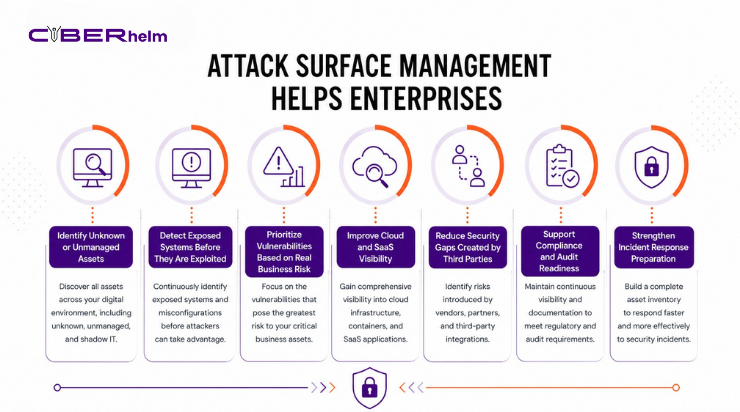
Attack surface management helps enterprises:
- Identify unknown or unmanaged assets
- Detect exposed systems before they are exploited
- Prioritize vulnerabilities based on real business risk
- Improve cloud and SaaS visibility
- Reduce security gaps created by third parties
- Support compliance and audit readiness
- Strengthen incident response preparation
This matters most for organizations with complex operations, multiple branches, hybrid infrastructure, or regulated data.
ASM Is Not Just Vulnerability Scanning
Traditional vulnerability scanning usually checks known systems for known weaknesses. Attack surface management goes further because it starts with discovery. It asks: “What assets exist, where are they exposed, and how could an attacker approach them?”
A strong ASM program includes:
Area | What It Checks |
External Assets | Domains, IPs, subdomains, applications, portals |
Cloud Exposure | Storage buckets, cloud services, access points |
Identity Risk | Leaked credentials, weak authentication, exposed admin panels |
Third-Party Risk | Vendor systems, supplier access, partner integrations |
Brand Abuse | Impersonation domains, phishing pages, fake profiles |
Vulnerability Context | Which weaknesses matter most based on exploitability |
This makes ASM more practical for decision-making. Instead of giving teams a long list of technical issues, it helps them understand which exposures need urgent action.
How Attack Surface Management Works
A mature ASM program usually follows a continuous cycle.
1. Discover Every External Asset
The first step is to identify all internet-facing assets connected to the organization. This includes official assets as well as forgotten, shadow, or unmanaged ones. Discovery should cover cloud platforms, web apps, domains, employee-facing portals, remote access tools, and third-party connections.
2. Classify Business-Critical Systems
Not every asset carries the same risk. A public marketing page and an exposed admin login are not equal. Classification helps teams separate low-risk assets from systems that support finance, customer data, operations, intellectual property, or regulated information.
3. Detect Misconfigurations and Weaknesses
After discovery, the next step is to check for exposed services, outdated software, weak SSL settings, risky permissions, open storage, missing authentication, or known vulnerabilities. This helps security teams move from assumption to evidence.
4. Prioritize by Real Risk
Security teams often struggle because every tool creates alerts. ASM becomes valuable when it ranks issues based on severity, exploitability, asset value, and business impact. A minor issue on a low-value system may wait, but an exposed login linked to sensitive data needs fast remediation.
5. Validate with Offensive Testing
Attack surface findings become stronger when they are tested safely through red team methods, penetration testing, and adversary simulation. This is where Offensive Security plays an important role. It helps organizations understand whether a weakness is only theoretical or actually exploitable.
6. Monitor Continuously
Attack surfaces change every day. A one-time assessment is not enough. Continuous monitoring helps teams detect new assets, risky changes, credential leaks, and digital threats as they appear.
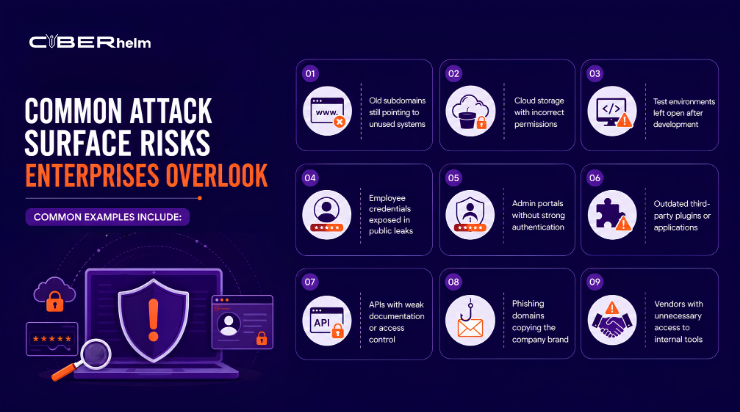
Common Attack Surface Risks Enterprises Overlook
Many organizations already invest in firewalls, endpoint protection, and access controls. Still, exposure often comes from areas that are easy to miss.
Common examples include:
- Old subdomains still pointing to unused systems
- Cloud storage with incorrect permissions
- Test environments left open after development
- Employee credentials exposed in public leaks
- Admin portals without strong authentication
- Outdated third-party plugins or applications
- APIs with weak documentation or access control
- Phishing domains copying the company brand
- Vendors with unnecessary access to internal tools
These issues may look small individually, but together they create a larger risk picture.
Connecting ASM with Threat Intelligence
Attack surface management becomes more powerful when it is combined with cyber threat intelligence. Threat intelligence helps security teams understand which attackers, tactics, campaigns, and indicators may be relevant to their industry.
For example, if threat actors are targeting financial portals, healthcare data, or government suppliers, an enterprise can use that intelligence to prioritize exposed systems in those areas. This turns ASM from a technical inventory into a proactive defense strategy.
Dark web exposure also matters. Stolen credentials, leaked documents, and brand impersonation can appear outside the company’s direct infrastructure. Internal teams can strengthen this layer by reviewing Dark Web Monitoring as part of a wider cyber visibility program.
How ASM Supports Compliance and Governance
Compliance frameworks often require asset visibility, risk assessment, access management, and evidence of control. Attack surface management supports these requirements by creating a clearer record of external risks and remediation activity.
It can support:
- ISO 27001 security management
- NIST cybersecurity alignment
- PCI DSS exposure reduction
- SOC 2 security controls
- Vendor and third-party risk programs
- Board-level cyber risk reporting
For organizations building mature governance programs, GRC as a Service can help connect technical exposure management with policy, audit readiness, and continuous compliance.
Why Defensive Teams Need ASM Data
Security operations teams need useful visibility, not just more alerts. ASM data helps defensive teams understand where monitoring should be improved, which assets should be watched closely, and what risks need playbooks.
When integrated with Defensive Security, ASM can improve threat hunting, incident response, SIEM/SOAR use cases, and detection engineering. This creates a stronger bridge between external visibility and internal defense.
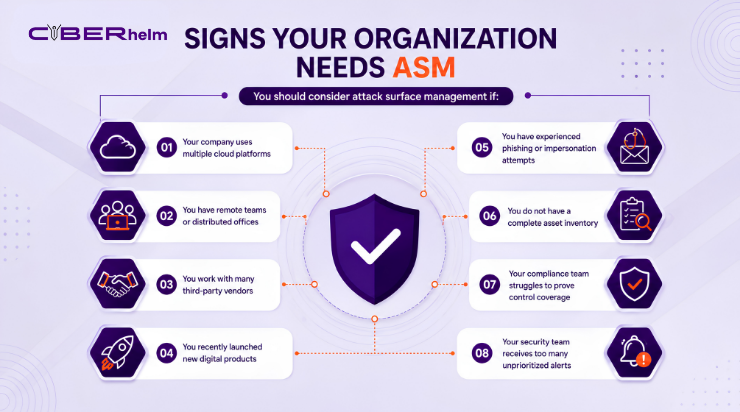
Signs Your Organization Needs ASM
You should consider attack surface management if:
- Your company uses multiple cloud platforms
- You have remote teams or distributed offices
- You work with many third-party vendors
- You recently launched new digital products
- You have experienced phishing or impersonation attempts
- You do not have a complete asset inventory
- Your compliance team struggles to prove control coverage
- Your security team receives too many unprioritized alerts
ASM is not only for large enterprises. Any organization with public-facing digital systems can benefit from better exposure visibility.
Practical Steps to Start
A good starting point is to create a baseline view of your external environment. List known domains, applications, cloud services, vendors, login portals, and critical systems. Then compare that list with external discovery results. The gaps are often where risk begins.
Next, assign ownership. Every exposed asset should have a business owner, technical owner, and remediation path. Without ownership, findings stay unresolved.
Finally, connect ASM with existing security operations. Findings should not live in a separate report. They should feed into ticketing, incident response, compliance tracking, and executive risk reporting.
For more cybersecurity education and related insights, visit the CyberHelm Blogs section.
FAQs
1. What is attack surface management in cybersecurity?
Attack surface management is the process of discovering, monitoring, and reducing all digital assets that could be targeted by attackers. It includes domains, applications, cloud services, APIs, credentials, and third-party exposures.
2. Is attack surface management the same as vulnerability scanning?
No. Vulnerability scanning checks known systems for known weaknesses. Attack surface management starts by discovering all exposed assets, including unknown or unmanaged ones, and then prioritizes risk based on business impact.
3. How often should enterprises review their attack surface?
Enterprises should monitor their attack surface continuously because digital environments change frequently. New systems, cloud services, vendors, and user accounts can create exposure at any time.
4. Does ASM help with compliance?
Yes. ASM supports compliance by improving asset visibility, documenting risk, tracking remediation, and helping organizations prove that external exposures are being managed responsibly.
Conclusion
Attackers do not need to break through every defense. They only need one exposed asset, one weak credential, or one forgotten system. Attack surface management helps enterprises find those weaknesses first, reduce risk, and build a stronger cyber defense program.
To strengthen your visibility, reduce exposure, and build a more resilient cybersecurity strategy, contact CyberHelm to discuss the right security approach for your organization.