The Impact of Artificial Intelligence on Cybersecurity Compliance
As businesses increasingly rely on digital systems and data, cybersecurity has become a top priority. However, it’s not just about preventing attacks — organizations must also ensure compliance with a growing number of data protection regulations. From the General Data Protection Regulation (GDPR) to the California Consumer Privacy Act (CCPA), organizations face stringent requirements designed to protect sensitive data and ensure privacy.
Enter Artificial Intelligence (AI) — a transformative technology that’s reshaping the way businesses approach cybersecurity compliance. AI not only helps companies stay one step ahead of cyber threats but also enables them to automate, streamline, and enhance their compliance efforts. In this blog, we’ll explore how AI is revolutionizing cybersecurity compliance, the benefits it offers, and the challenges businesses face when integrating AI into their compliance strategies.
The Growing Complexity of Cybersecurity Compliance
As data privacy laws continue to evolve, the complexity of cybersecurity compliance grows. Regulations like the GDPR, CCPA, and HIPAA have strict requirements for businesses, including how data is stored, protected, and accessed. Non-compliance can result in hefty fines, legal repercussions, and reputational damage.
For many organizations, maintaining compliance can be a challenge. Manual processes, limited resources, and an increasing number of devices and data sources make it difficult to keep track of compliance status across an entire organization. This is where AI comes in — offering solutions that automate and simplify the compliance process.
AI-Driven Solutions for Cybersecurity Compliance
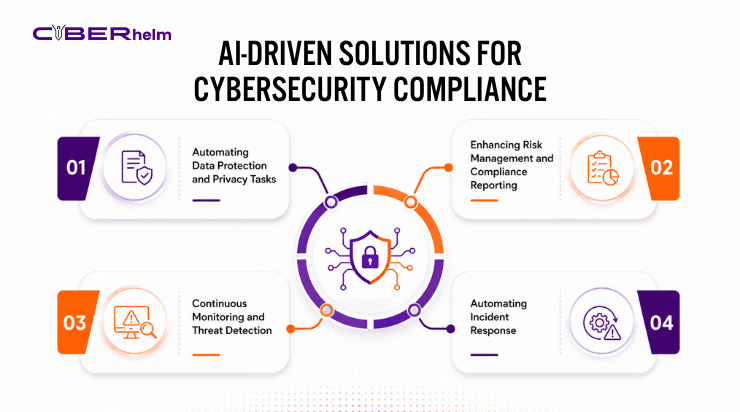
AI has the potential to significantly improve how businesses manage cybersecurity compliance. By leveraging machine learning, natural language processing (NLP), and predictive analytics, AI can streamline various aspects of compliance, from risk assessments to data protection. Below are some key areas where AI is making a real impact:
1. Automating Data Protection and Privacy Tasks
One of the biggest challenges for organizations is ensuring that sensitive data is properly protected in accordance with compliance regulations. AI can automate tasks such as data classification, encryption, and data access controls to ensure compliance with privacy laws. AI algorithms can continuously monitor data flows, identify sensitive data, and flag any potential vulnerabilities that may expose this data to unauthorized access.
By using AI-driven systems, businesses can automate:
- Data classification and tagging: Automatically classifying data based on its sensitivity level and applying appropriate security measures.
- Access control: Ensuring that only authorized personnel can access sensitive data and that access is logged and auditable.
- Data encryption: Applying encryption protocols to protect sensitive data in transit and at rest.
2. Enhancing Risk Management and Compliance Reporting
AI tools can help organizations conduct thorough risk assessments and generate detailed compliance reports. These tools can analyze large volumes of data and identify potential risks to data security or areas of non-compliance with regulations. With the help of AI, businesses can better understand their security posture and take proactive steps to mitigate risks before they become issues.
AI can also automate reporting by gathering the necessary information and generating compliance reports in real-time. This reduces the time and effort required to produce reports manually, allowing organizations to remain compliant with minimal manual intervention.
3. Continuous Monitoring and Threat Detection
AI-powered systems can continuously monitor network traffic, user behavior, and other data sources for suspicious activities or potential threats. By using machine learning algorithms, AI can detect anomalies that may indicate a compliance violation, such as unauthorized data access or unusual data transfer patterns.
The AI system can automatically trigger alerts or even take corrective actions (such as blocking access to certain data or isolating affected systems) to prevent breaches. This real-time monitoring ensures that organizations remain compliant at all times, even as cyber threats evolve.
4. Automating Incident Response
In the event of a cyberattack or data breach, a swift response is critical to minimizing damage and ensuring compliance. AI can help businesses automate their incident response processes by quickly identifying the root cause of the breach, containing the threat, and ensuring that data privacy laws are adhered to.
AI systems can automatically execute predefined response protocols to contain the threat, collect evidence for forensic investigation, and inform stakeholders in compliance with regulatory requirements. This reduces the time it takes to respond to incidents and helps businesses stay compliant with incident reporting laws.
The Benefits of AI for Cybersecurity Compliance
- Improved Efficiency
AI reduces the time and effort needed to manage compliance tasks. By automating routine processes like data classification, encryption, and reporting, organizations can focus their resources on higher-priority tasks. This leads to more efficient compliance management and a reduction in human error. - Cost Savings
Traditional compliance efforts often involve significant manual labor and dedicated teams. By using AI to automate many of these tasks, businesses can save on labor costs and reduce the risk of costly penalties due to non-compliance. - Enhanced Security Posture
AI can continuously monitor systems for compliance violations and potential threats, helping organizations maintain a stronger security posture. Proactive monitoring and real-time threat detection minimize the risk of security breaches and ensure that businesses are meeting the necessary compliance standards. - Scalability
As businesses grow and the number of IoT devices, users, and data sources increases, AI-driven compliance solutions can scale with the organization. Unlike traditional manual compliance efforts, AI can adapt to changing business environments, ensuring that compliance efforts remain effective even as the organization evolves.
Challenges and Considerations
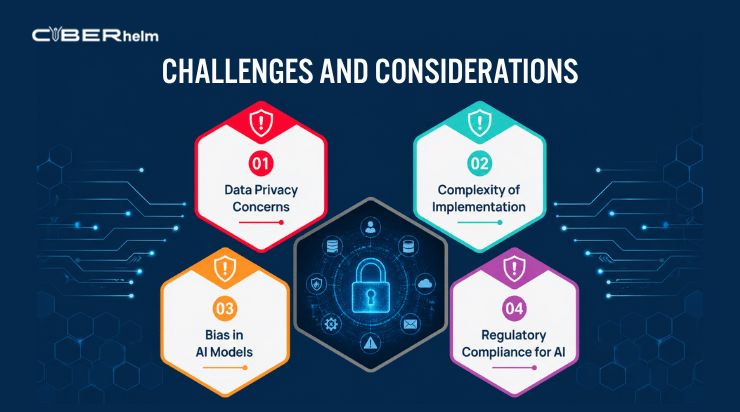
While AI has the potential to significantly enhance cybersecurity compliance, there are challenges and considerations to keep in mind:
- Data Privacy Concerns
Using AI for compliance requires access to vast amounts of data. This raises potential concerns regarding data privacy and the ethical use of AI. Organizations must ensure that AI systems themselves are compliant with data privacy laws and that sensitive information is protected. - Complexity of Implementation
Implementing AI-driven compliance solutions can be complex, requiring significant technical expertise and integration with existing security infrastructure. Businesses may need to invest in training, support, and resources to effectively deploy AI-powered solutions. - Bias in AI Models
AI systems are only as good as the data they are trained on. If the data used to train the models is incomplete or biased, it could lead to inaccurate compliance assessments or ineffective risk detection. It’s important for organizations to use high-quality, representative data to ensure the AI models perform optimally. - Regulatory Compliance for AI
As AI becomes more prevalent in cybersecurity, there will likely be an increase in regulations governing its use. Organizations will need to stay informed about emerging laws related to AI ethics, transparency, and accountability to ensure they remain compliant.
Conclusion: Embracing AI for Smarter Cybersecurity Compliance
The integration of AI into cybersecurity compliance is not just a trend — it’s a necessity for organizations looking to stay ahead of cyber threats while meeting the increasingly complex regulatory requirements. With AI’s ability to automate tasks, enhance security, and streamline compliance reporting, businesses can create a more efficient, scalable, and secure compliance strategy.
As regulations continue to evolve, organizations that leverage AI for cybersecurity compliance will be better positioned to not only meet compliance requirements but also mitigate risks and improve their overall security posture. By embracing AI, businesses can future-proof their compliance efforts and ensure that they are ready to face the challenges of tomorrow’s cybersecurity landscape.