- Home
- Blog
Inside the Mind of an Attacker – Why Red Teaming and Offensive Security Are Vital for Enterprise Resilience

Inside the Mind of an Attacker
Every organization today has security controls, firewalls, endpoint protection, and identity systems. Yet, headlines continue to report sophisticated breaches affecting even the most “secured” enterprises. Why?
Because cyber attackers don’t play by the rules. They don’t test systems in isolation; they exploit human error, misconfigurations, and overlooked weak spots across entire ecosystems.
That’s why Offensive Security, especially Red Teaming, has become indispensable. It’s not about testing your tools; it’s about testing your readiness.
At CyberHelm, we think like adversaries so you can defend like leaders.
From Penetration Testing to Red Teaming: The Next Evolution
Traditional penetration testing identifies known vulnerabilities in applications, networks, and systems, a vital step, but often limited in scope.
Red Teaming goes beyond that. It’s a full-scale simulation of real-world attacks, designed to test your defenses, detection capabilities, and incident response across people, processes, and technology.
While pen testing answers “What can be exploited?”Red Teaming asks, “How far could an attacker go, and would you even notice?”
How Red Teaming Strengthens Enterprise Resilience
CyberHelm’s Red Team operations follow a threat intelligence-led methodology inspired by real adversary tactics. Each engagement is unique, stealthy, and outcome-driven.
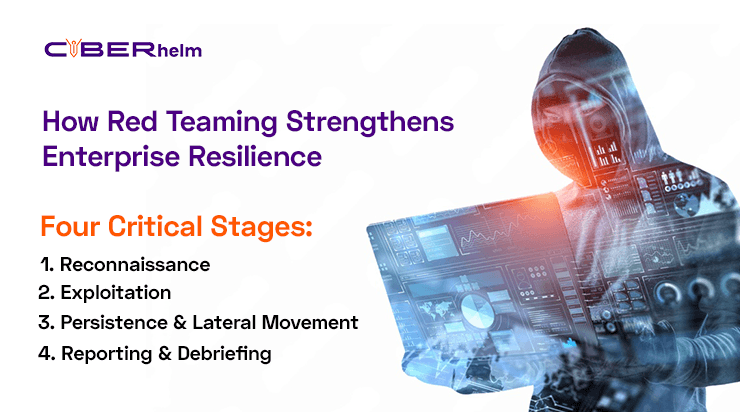
Our approach focuses on four critical stages:
- Reconnaissance – Gathering open-source and deep web intelligence to map your digital footprint and identify attack vectors.
- Exploitation – Simulating intrusion attempts through phishing, privilege escalation, or exploiting application vulnerabilities.
- Persistence & Lateral Movement – Emulating advanced threat actor techniques to test how long we can maintain undetected access.
- Reporting & Debriefing – Delivering actionable insights, attack timelines, and mitigation strategies for immediate hardening.
CyberHelm’s Red Team operations follow a threat intelligence-led methodology inspired by real adversary tactics. Each engagement is unique, stealthy, and outcome-driven.
Our approach focuses on four critical stages:
- Reconnaissance – Gathering open-source and deep web intelligence to map your digital footprint and identify attack vectors.
- Exploitation – Simulating intrusion attempts through phishing, privilege escalation, or exploiting application vulnerabilities.
- Persistence & Lateral Movement – Emulating advanced threat actor techniques to test how long we can maintain undetected access.
- Reporting & Debriefing – Delivering actionable insights, attack timelines, and mitigation strategies for immediate hardening.
This mirrors how a real adversary operates, except the attacker, in this case, is on your side.

Offensive Security in Practice: The CyberHelm Advantage
What sets CyberHelm apart is our combination of Red Team expertise, threat intelligence integration, and real-world attacker behavior modeling.
Our offensive specialists:
- Use the latest TTPs (Tactics, Techniques & Procedures) aligned with MITRE ATT&CK.
- Leverage proprietary threat intelligence feeds to model current adversary groups.
- Tailor engagements to simulate industry-specific threats, from ransomware groups to nation-state actors.
- Collaborate with your Blue Team to enhance incident detection and response capabilities.
This Red + Blue collaboration forms a Purple Team feedback loop, ensuring continuous learning and resilience building.
Why Enterprises Can’t Afford to Skip Offensive Testing
For regulated industries like finance, healthcare, and government, offensive testing isn’t optional; it’s a strategic necessity.
- Identifies hidden risks before they become breaches.
- Test your people, including how effectively your SOC detects and responds.
- Builds executive confidence in your cybersecurity posture.
- Supports compliance with frameworks such as ISO 27001, PCI-DSS, and NIST 800-53.
Without offensive validation, even the best defensive controls remain untested assumptions.
Case Insight: Simulating the Unseen Threat
When a global fintech firm engaged CyberHelm for a covert Red Team assessment, the exercise uncovered a critical access path through a forgotten development server. Within 48 hours, our team demonstrated potential lateral movement to sensitive client data, a scenario previously undetected by existing monitoring tools.
The result?
The organization restructured its access management policy, achieving 60% faster threat detection and zero privilege escalation incidents in the next six months.
Ready to see your organization through the eyes of an attacker?
Explore CyberHelm’s Offensive Security Services and discover how Red Teaming can fortify your enterprise resilience.
Conclusion: Think Like an Attacker. Act Like a Leader.
Cyber resilience isn’t achieved by adding more tools; it’s achieved by understanding your weaknesses before someone else does.
Offensive Security transforms organizations from reactive defenders to proactive strategists. It challenges complacency, validates readiness, and empowers leadership with real-world visibility.
At CyberHelm, we don’t just test systems; we simulate adversaries to prepare you for the threats that truly matter.
Categories
- Network Security
- network security
- Compliance & Governance
- Compliance
- Industry News
Related Posts

Book a Free Consultation
CyberHelm’s Managed Security delivers cutting-edge protection with expert oversight. We provide 24/7 monitoring, threat intelligence, and proactive defense so your team can focus on growth while we handle security.
Call Now
0800 7870200